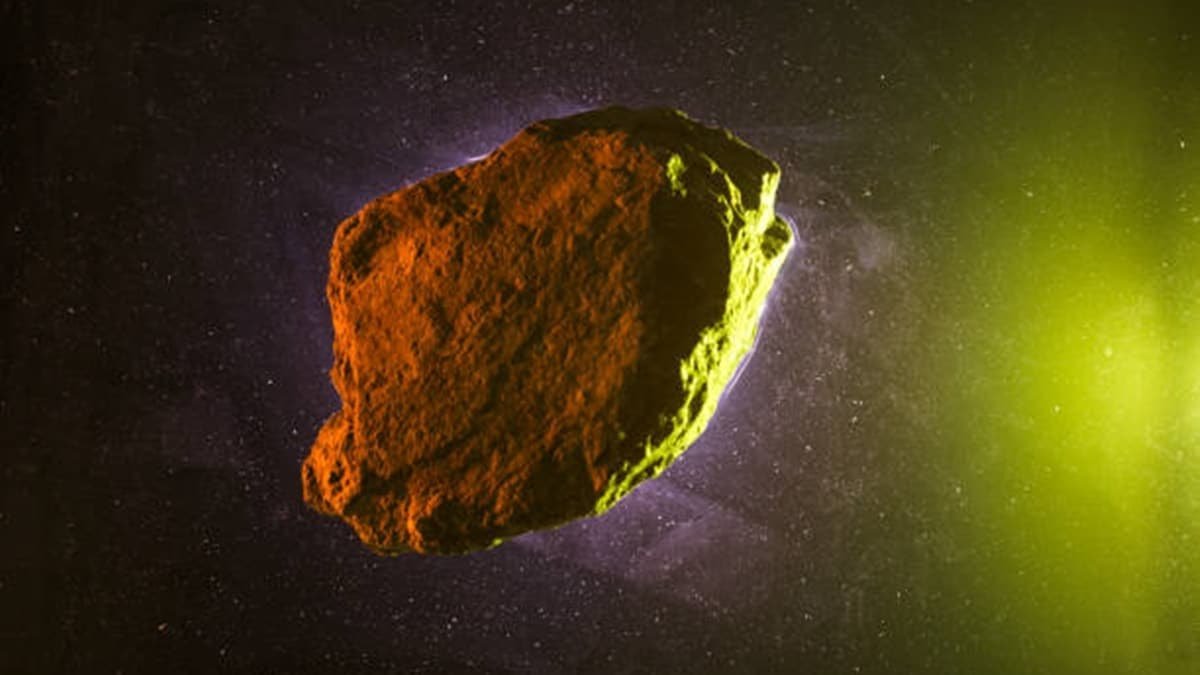
While the asteroid will pass the Earth from a distance nine times that of between Earth and the Moon, the object will be cruising at a massive speed of 94,208 kilometres per hour.
Asteroids have always been a cause of concern for astronomers worldwide, and an object approximately 4,500 feet in diameter has joined the list as it approaches Earth. Nasa has classified asteroid 2016 AJ193 as potentially hazardous as it comes close to Earth on the night of August 21.
While the http://asteroid will pass the Earth from a distance nine times that of between Earth and the Moon the object will be cruising at a massive speed of 94,208 kilometres per hour. Astronomers will be able to watch the 1.4-kilometre-wide asteroid move past Earth in its orbit using telescopes.
The object, classified as potentially hazardous, will next come close to Earth in 2063. Nasa has predicted its orbital track and expects no harm to the planet this time.
The asteroid was first spotted by the Panoramic Survey Telescope and Rapid Response System (Pan-STARRS) facility located at Haleakala Observatory, Hawaii in January 2016 after which http://Nasa used the NEOWISE spacecraft to observe the flying object.
According to EarthSky, astronomers noticed that the asteroid is very dark (not very reflective), and its rotation period, pole direction, and spectral class are all unknown.
The asteroid orbits around the Sun every 5.9 years as it gets relatively close to Earth’s orbit. (Photo: Nasa)
The asteroid orbits around the Sun every 5.9 years as it gets relatively close to Earth’s orbit but then travels beyond the orbit of Jupiter. The August 21 flyby will be this asteroid’s closest approach to Earth at least for the next 65 years, the longest period for which its orbit has been calculated.
What are asteroids?
Asteroids are rocky fragments left over from the formation of the solar system about 4.6 billion years ago. According to the Nasa Joint Propulsion Laboratory (JPL), which tracks asteroid movement, an asteroid is classified as a near-Earth object when its distance from our planet is less than 1.3 times the distance from Earth to the Sun (the Earth-Sun distance is about 93 million miles).
CHECK THESE OUT
MORE
Man-made collision or explosion? Mysterious impact in space that damaged Chinese spy satellite
RECOMMENDED
Comet ATLAS may have been part of object that dazzled Earth 5,000 years ago
RECOMMENDED
Is there life on Mars? Curiosity begins exploring region full of clay, salty minerals
RECOMMENDED
There is a break in our galaxy: Astronomers find unique structures coming out of Milky Way
RECOMMENDED
This is how Venus sounds: Listen to first audio recordings from Earth’s mysterious twin
RECOMMENDED
European satellite can map Earth multiple times a day, set to boost defence monitoring capability
RECOMMENDED
Nasa tracks over 26,000 near-Earth asteroids and over 1,000 of these are considered potentially hazardous. The agency tracks the movement of the asteroid around Sun to establish its location, computing an elliptical path that best fits the available observations of the object.
Click here for IndiaToday.in’s complete coverage of the coronavirus pandemic.

 World press